
3 Energy systems
Whenever you move—whether it’s standing up, walking, eating, or doing any kind of exercise—your body relies on an “engine” to power the action. In fact, the body has three different engines, and as soon as you start moving, all three kick in at once.
These engines drive your muscles (and the rest of your body’s systems), and in sports science they’re known as the energy systems. Even though they all switch on together, each one has unique characteristics that let your body handle different types of effort.
Most sports draw on all three energy systems. Take rugby, for example: a full 80-minute match relies heavily on the Aerobic system, but the short bursts of power in scrums call on the ATP-PC system.
The ATP-PC System
This system works without oxygen, drawing on creatine phosphate and ATP that are already stored in the muscles. It’s a straightforward engine that kicks in instantly. In terms of output, it delivers a huge amount of power very quickly—but it can’t sustain that effort for long.
At its best, it runs at peak efficiency for about 7 to 10 seconds, and can keep going effectively for up to 30 seconds. After that, it drops off sharply as the available energy is used up. The ATP-PC system is what fuels all short, explosive movements—whether it’s a sprint or a heavy lift in weightlifting.
ATP-PC system characteristics
Capacity: Low
Engine: powerful
Power: very high but short-lived
The Lactic Acid System
Like the ATP-PC system, this engine also works without oxygen, but instead it relies on carbohydrates—mainly glucose and glycogen stored in the muscles and liver—as its fuel source. Because it’s more complex, it takes a little longer to kick in.
The anaerobic lactic system takes over once the ATP-PC system has run its course. It reaches peak efficiency after about 30 seconds of effort and can remain effective for up to 2–3 minutes.
This system comes into play during high-intensity efforts lasting between 30 seconds and 3 minutes. Classic examples include a 400 m or 800 m race in track and field, or a 100 m or 200 m swim.
Lactic Acid system characteristics
Capacity: moderate
Engine: moderate
Power: moderate but longer-lasting
The Aerobic System
Unlike the other two systems, the aerobic system works with oxygen. Like the others, it switches on as soon as exercise begins, but it only becomes fully effective after about 2 to 3 minutes.
This engine produces less power, but it can keep going for a very long time—sometimes indefinitely.
To run, the aerobic system uses oxygen to break down fuel. In the first 40 minutes or so, it mainly burns glucose and glycogen (from carbohydrates). After that, it begins to rely more heavily on lipids (fat). Because the body has such large fat reserves, this system can sustain activity for a long time. That’s why the aerobic system is crucial for long-duration efforts—like hiking, cycling, or middle- to long-distance running events.
Aerobic system characteristics
Capacity: very high (unlimited)
+ oxygen
Engine: small
Power: low but very long-lasting
The common points between the three energy systems
1
All three systems switch on right from the start of any activity or effort, even the smallest movements.
2
Each system increases heart rate. You can target specific training zones by knowing your maximum heart rate (HR max). See our article on on HR and HRmax.
3
Which system is used most depends on intensity and duration. More precisely, it’s tied to your percentage of MAS (Maximal Aerobic Speed) or MAP (Maximal Aerobic Power). See our article on MAS.
4
Each system is defined by two key factors
Power : its ability to deliver the maximum amount of energy in a short time.
Capacity : its ability to keep going as time passes and fuel stores run low.
Heart Rate, VO₂ max, and MAS
For any individual—regardless of their profile or fitness level—exercise always leads to an increase in heart rate. The effort a person can sustain reflects a balance between the power and the capacity of the energy system being used. The higher the power output, the lower the capacity will be, and vice versa.
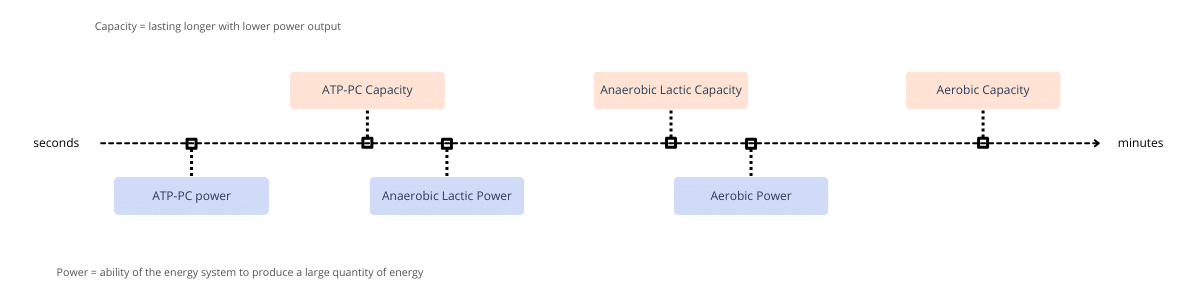
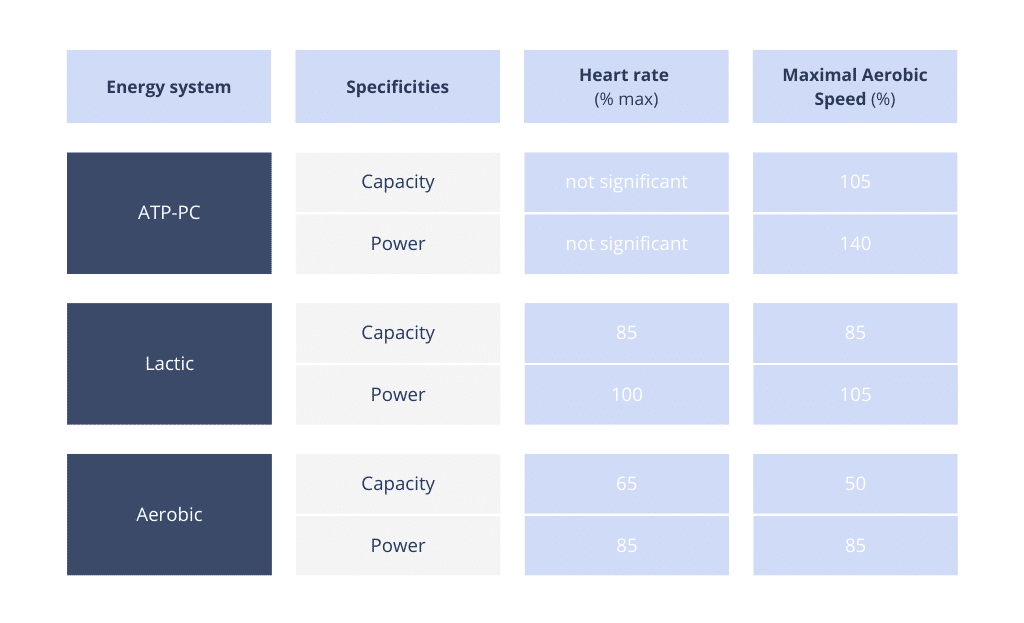
Likewise, during endurance activity, the activation of an energy system corresponds to a percentage of maximal aerobic speed (MAS) or maximal aerobic power (MAP). As explained in a previous article, an athlete reaches their MAS at the point where they also hit their VO₂ max. All of these concepts are interconnected and primarily relate to the aerobic system.
The table below shows the different values of heart rate (HR) and MAS, depending on the capacity and power of each energy system.
Energy Systems: Swimming Sets
You can find more concrete examples of swimming workouts in our dedicated article on interval training.
The ATP-PC System

The Lactic Acid System

The Aerobic System
As we’ve seen above, this system becomes the primary one as soon as the effort is sustained over time. In a middle-distance or long-distance event, even if you set a new personal best, you’ll still be working aerobically.
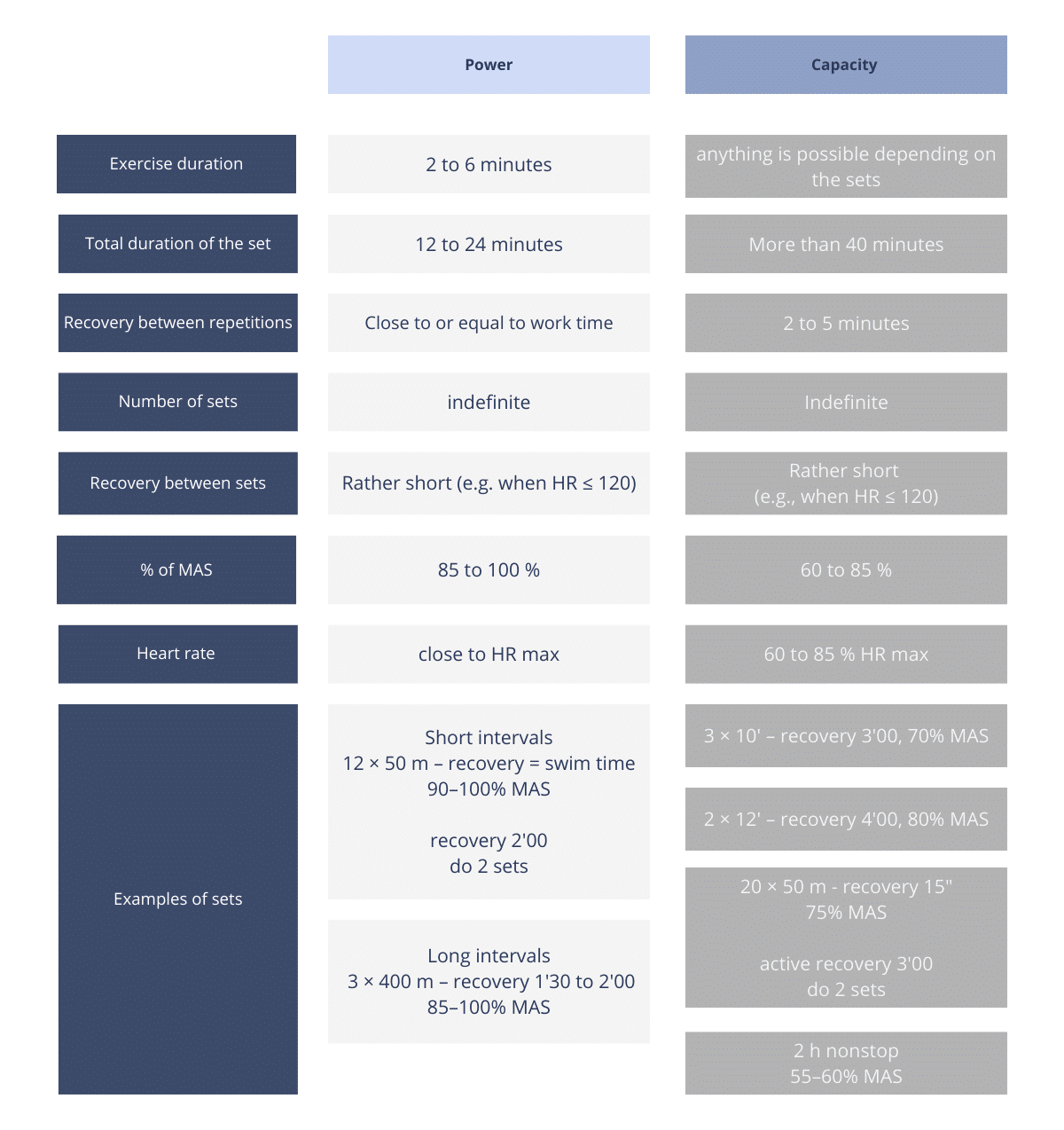
The possible combinations of aerobic-focused sessions are virtually endless, and they tie back to the principles ofinterval training with its five key components.
To make it easier to understand, some elements of the article have been simplified. It is designed to simplify and explain — it’s not a scientific paper. It covers general, basic cases and is not meant to provide individualized prescriptions. Remember: variations between people are influenced by many factors, so some details may not apply to you personally.